Article

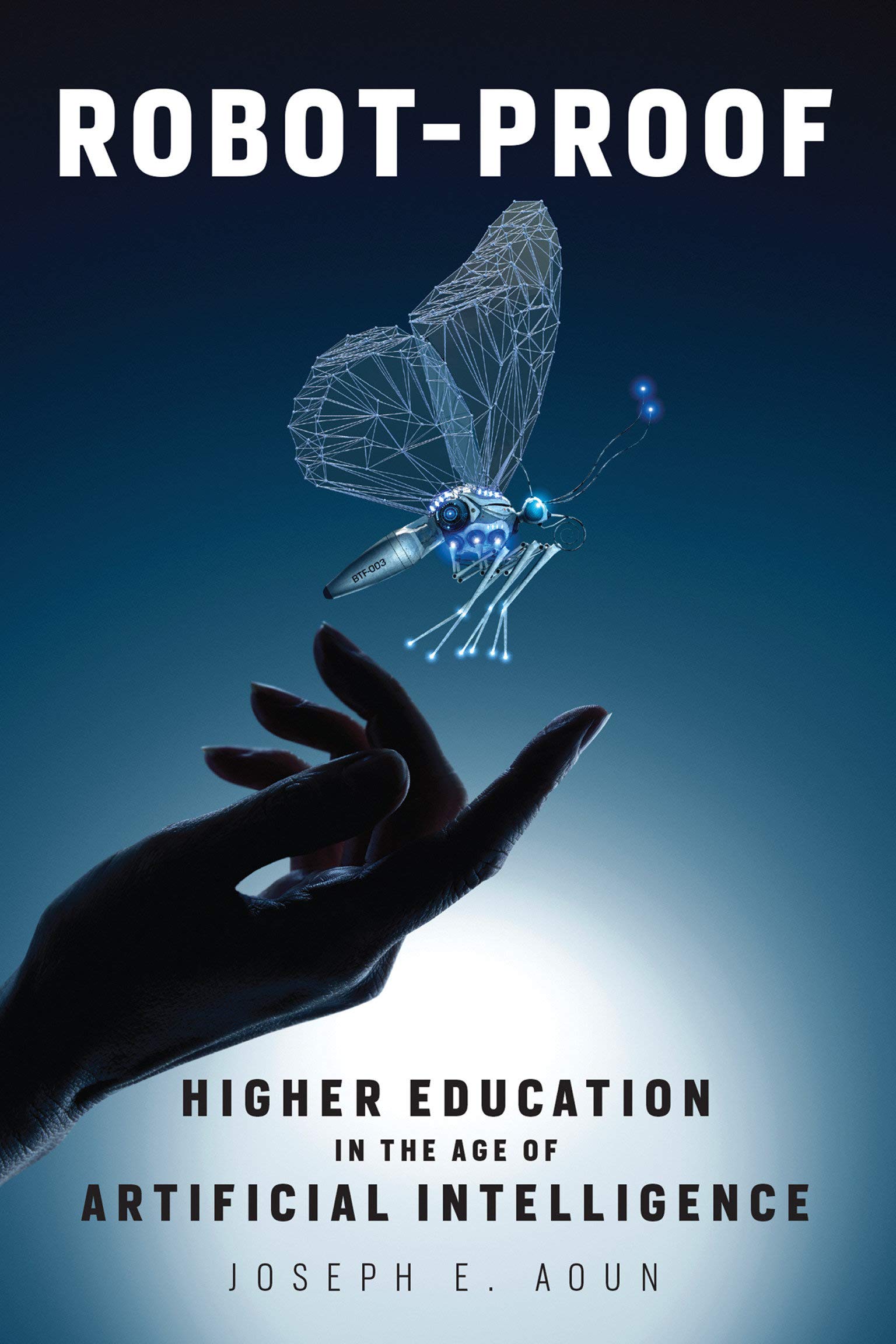
Robot-Proof: Higher Education in the Age of Artificial Intelligence (The MIT Press)

How to educate the next generation of college students to invent, to create, and to discover—filling needs that even the most sophisticated robot cannot.<p>Driverless cars are hitting the road, powered by artificial intelligence. Robots can climb stairs, open doors, win Jeopardy, analyze stocks, work in factories, find parking spaces, advise oncologists. In the past, automation was considered a threat to low-skilled labor. Now, many high-skilled functions, including interpreting medical images, doing legal research, and analyzing data, are within the skill sets of machines. How can higher education prepare students for their professional lives when professions themselves are disappearing? In Robot-Proof, Northeastern University president Joseph Aoun proposes a way to educate the next generation of college students to invent, to create, and to discover—to fill needs in society that even the most sophisticated artificial intelligence agent cannot.</p><p>A “robot-proof” education, Aoun argues, is not concerned solely with topping up students' minds with high-octane facts. Rather, it calibrates them with a creative mindset and the mental elasticity to invent, discover, or create something valuable to society—a scientific proof, a hip-hop recording, a web comic, a cure for cancer. Aoun lays out the framework for a new discipline, humanics, which builds on our innate strengths and prepares students to compete in a labor market in which smart machines work alongside human professionals. The new literacies of Aoun's humanics are data literacy, technological literacy, and human literacy. Students will need data literacy to manage the flow of big data, and technological literacy to know how their machines work, but human literacy—the humanities, communication, and design—to function as a human being. Life-long learning opportunities will support their ability to adapt to change.</p><p>The only certainty about the future is change. Higher education based on the new literacies of humanics can equip students for living and working through change.</p> <br><br> Publisher ‏ : ‎ The MIT Press; Reprint edition (August 14, 2018) <br> Language ‏ : ‎ English <br> Paperback ‏ : ‎ 210 pages <br> ISBN-10 ‏ : ‎ 0262535971 <br> ISBN-13 ‏ : ‎ 978-0262535977 <br> Item Weight ‏ : ‎ 8.8 ounces <br> Dimensions ‏ : ‎ 5.38 x 0.56 x 8 inches <br>

Discount Price: [price_with_discount]


(as of [price_update_date] - Details)

[ad_1]

Description


Robot-Proof: Higher Education in the Age of Artificial Intelligence (The MIT Press)
- How to educate the next generation of college students to invent, to create, and to discover—filling needs that even the most sophisticated robot cannot.

Driverless cars are hitting the road, powered by artificial intelligence. Robots can climb stairs, open doors, win Jeopardy, analyze stocks, work in factories, find parking spaces, advise oncologists. In the past, automation was considered a threat to low-skilled labor. Now, many high-skilled functions, including interpreting medical images, doing legal research, and analyzing data, are within the skill sets of machines. How can higher education prepare students for their professional lives when professions themselves are disappearing? In Robot-Proof, Northeastern University president Joseph Aoun proposes a way to educate the next generation of college students to invent, to create, and to discover—to fill needs in society that even the most sophisticated artificial intelligence agent cannot.

A “robot-proof” education, Aoun argues, is not concerned solely with topping up students' minds with high-octane facts. Rather, it calibrates them with a creative mindset and the mental elasticity to invent, discover, or create something valuable to society—a scientific proof, a hip-hop recording, a web comic, a cure for cancer. Aoun lays out the framework for a new discipline, humanics, which builds on our innate strengths and prepares students to compete in a labor market in which smart machines work alongside human professionals. The new literacies of Aoun's humanics are data literacy, technological literacy, and human literacy. Students will need data literacy to manage the flow of big data, and technological literacy to know how their machines work, but human literacy—the humanities, communication, and design—to function as a human being. Life-long learning opportunities will support their ability to adapt to change.

The only certainty about the future is change. Higher education based on the new literacies of humanics can equip students for living and working through change.


Publisher ‏ : ‎ The MIT Press; Reprint edition (August 14, 2018)
Language ‏ : ‎ English
Paperback ‏ : ‎ 210 pages
ISBN-10 ‏ : ‎ 0262535971
ISBN-13 ‏ : ‎ 978-0262535977
Item Weight ‏ : ‎ 8.8 ounces
Dimensions ‏ : ‎ 5.38 x 0.56 x 8 inches

-[ad_2]

Rating


Rating Star: 4.5

Related Reads

ai-book

Handbook of Artificial Intelligence for Music: Foundations, Advanced Approaches, and Developments for Creativity

This book presents comprehensive coverage of the latest advances in research into enabling machines to listen to and compose new music. It includes chapters introducing what we know about human musical intelligence and on how this knowledge can be simulated with AI. The development of interactive musical robots and emerging new approaches to AI-based musical creativity are also introduced, including brain–computer music interfaces, bio-processors and quantum computing.<br>Artificial Intelligence (AI) technology permeates the music industry, from management systems for recording studios to recommendation systems for online commercialization of music through the Internet. Yet whereas AI for online music distribution is well advanced, this book focuses on a largely unexplored application: AI for creating the actual musical content. <br><br> ASIN ‏ : ‎ B09NZ7177S <br> Publication date ‏ : ‎ December 20, 2021 <br> Language ‏ : ‎ English <br> File size ‏ : ‎ 19032 KB <br> Simultaneous device usage ‏ : ‎ Unlimited <br> Text-to-Speech ‏ : ‎ Enabled <br> Screen Reader ‏ : ‎ Supported <br> Enhanced typesetting ‏ : ‎ Enabled <br> X-Ray ‏ : ‎ Not Enabled <br> Word Wise ‏ : ‎ Enabled <br> Sticky notes ‏ : ‎ On Kindle Scribe <br> Print length ‏ : ‎ 1634 pages <br>

Read more →
ai-book

Artificial intelligence: 2023

in this book :<br>The inconceivable inventions of intuitive AI What do you get when you give a design tool a digital nervous system?<br>Can we make AI without losing control over it?<br>spooked of superintelligent AI?<br>Get ready for cold-blooded thinking<br>Machine intelligence makes mortal morals more important<br>The awful and intimidating counteraccusations of computers that can learn<br>How we are tutoring computers to understand filmland<br>What happens when our computers get smarter than we are? <br><br> ASIN ‏ : ‎ B0BTJ96J22 <br> Publication date ‏ : ‎ January 30, 2023 <br> Language ‏ : ‎ English <br> File size ‏ : ‎ 441 KB <br> Simultaneous device usage ‏ : ‎ Unlimited <br> Text-to-Speech ‏ : ‎ Enabled <br> Screen Reader ‏ : ‎ Supported <br> Enhanced typesetting ‏ : ‎ Enabled <br> X-Ray ‏ : ‎ Not Enabled <br> Word Wise ‏ : ‎ Enabled <br> Sticky notes ‏ : ‎ On Kindle Scribe <br> Print length ‏ : ‎ 68 pages <br>

Read more →
ai-book

Exploring the Limitless Imagination of DALL-E2 (Artificial Intelligence Book 10)

"Exploring the Limitless Imagination of DALL-E2 " is a groundbreaking book that delves deep into the world of artificial intelligence (AI) and its role in the creative process. Specifically, it explores the incredible capabilities of DALL-E2, an AI program that can generate a vast range of images based on textual input. This book provides a comprehensive guide to DALL-E2, offering readers a detailed understanding of how this technology works and the many ways it can be applied in various industries, such as art, design, architecture, healthcare, and more.<br><br>The book also explores the ethical and societal implications of AI-generated art, addressing concerns around ownership, authorship, and cultural representation. It examines how humans and AI-generated art can work together in the creative process and highlights successful collaborations between artists and AI programs. Furthermore, the book explores future developments in AI-generated art, such as advancements in AI technology and new use cases, and the potential impact these developments could have on society and the creative industries.<br><br>This book is a valuable resource for researchers, artists, designers, and anyone interested in exploring the fascinating world of AI-generated art. It offers insights into the latest trends and advancements in this field, providing a roadmap for future innovation and growth.<br><br> <br><br> ASIN ‏ : ‎ B0BZZBZDBP <br> Publication date ‏ : ‎ March 29, 2023 <br> Language ‏ : ‎ English <br> File size ‏ : ‎ 6701 KB <br> Text-to-Speech ‏ : ‎ Enabled <br> Screen Reader ‏ : ‎ Supported <br> Enhanced typesetting ‏ : ‎ Enabled <br> X-Ray ‏ : ‎ Not Enabled <br> Word Wise ‏ : ‎ Not Enabled <br> Sticky notes ‏ : ‎ On Kindle Scribe <br> Print length ‏ : ‎ 221 pages <br>

Read more →
ai-book

Artificial Intelligence Revolution: How AI Will Change our Society, Economy, and Culture

The co-founder of Baidu explains how AI will transform human livelihood, from our economy and financial systems down to our daily lives. <br><br> Written by Baidu cofounder Robin Li and prefaced by award-winning sci-fi writer Cixin Liu (author of The Three-Body Problem), Artificial Intelligence Revolution introduces Baidu’s teams of top scientists and management as pioneers of movement toward AI. The book covers many of the latest AI-related ideas and technological developments, such as: Computational abilityBig data resourcesSetting the basic standards of AI in research and developmentAn introduction to the “super brain”Intelligent manufacturingDeep learningL4 automated vehiclesSmart finance The book describes the emergence of a “smart” society powered by technology and reflects on the challenges humanity is about to face. Li covers the most pressing AI-related ideas and technological developments, including: Will artificial intelligence replace human workers, and in what sectors of the economy? How will it affect healthcare and finance? How will daily human life change? Robin Li’s Artificial Intelligence Revolution addresses these questions and more from the perspective of a pioneer of AI development. It's a must-read for anyone concerned about the emergence of a “smart” society powered by technology and the challenges humanity is about to face. <br><br> ASIN ‏ : ‎ B083ST8N5G <br> Publisher ‏ : ‎ Skyhorse (September 22, 2020) <br> Publication date ‏ : ‎ September 22, 2020 <br> Language ‏ : ‎ English <br> File size ‏ : ‎ 1403 KB <br> Text-to-Speech ‏ : ‎ Enabled <br> Screen Reader ‏ : ‎ Supported <br> Enhanced typesetting ‏ : ‎ Enabled <br> X-Ray ‏ : ‎ Enabled <br> Word Wise ‏ : ‎ Not Enabled <br> Sticky notes ‏ : ‎ On Kindle Scribe <br> Print length ‏ : ‎ 288 pages <br>

Read more →