Article

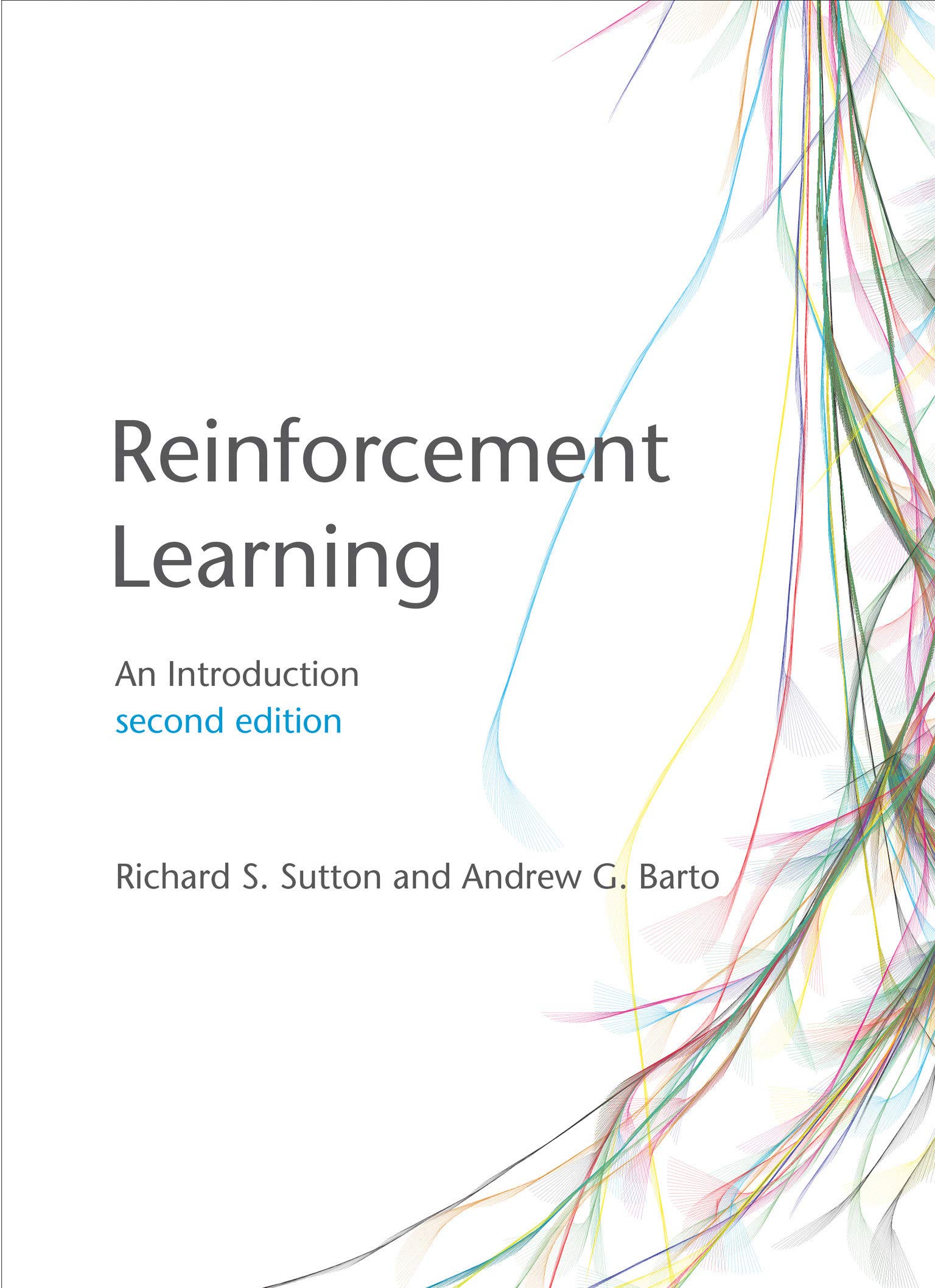
Reinforcement Learning, second edition: An Introduction (Adaptive Computation and Machine Learning series)

The significantly expanded and updated new edition of a widely used text on reinforcement learning, one of the most active research areas in artificial intelligence.<p>Reinforcement learning, one of the most active research areas in artificial intelligence, is a computational approach to learning whereby an agent tries to maximize the total amount of reward it receives while interacting with a complex, uncertain environment. In Reinforcement Learning, Richard Sutton and Andrew Barto provide a clear and simple account of the field's key ideas and algorithms. This second edition has been significantly expanded and updated, presenting new topics and updating coverage of other topics.</p><p>Like the first edition, this second edition focuses on core online learning algorithms, with the more mathematical material set off in shaded boxes. Part I covers as much of reinforcement learning as possible without going beyond the tabular case for which exact solutions can be found. Many algorithms presented in this part are new to the second edition, including UCB, Expected Sarsa, and Double Learning. Part II extends these ideas to function approximation, with new sections on such topics as artificial neural networks and the Fourier basis, and offers expanded treatment of off-policy learning and policy-gradient methods. Part III has new chapters on reinforcement learning's relationships to psychology and neuroscience, as well as an updated case-studies chapter including AlphaGo and AlphaGo Zero, Atari game playing, and IBM Watson's wagering strategy. The final chapter discusses the future societal impacts of reinforcement learning.</p> <br><br> Publisher ‏ : ‎ Bradford Books; second edition (November 13, 2018) <br> Language ‏ : ‎ English <br> Hardcover ‏ : ‎ 552 pages <br> ISBN-10 ‏ : ‎ 0262039249 <br> ISBN-13 ‏ : ‎ 978-0262039246 <br> Item Weight ‏ : ‎ 2.6 pounds <br> Dimensions ‏ : ‎ 7.25 x 1.48 x 9.31 inches <br>

Discount Price: [price_with_discount]


(as of [price_update_date] - Details)

[ad_1]

Description


Reinforcement Learning, second edition: An Introduction (Adaptive Computation and Machine Learning series)
- The significantly expanded and updated new edition of a widely used text on reinforcement learning, one of the most active research areas in artificial intelligence.

Reinforcement learning, one of the most active research areas in artificial intelligence, is a computational approach to learning whereby an agent tries to maximize the total amount of reward it receives while interacting with a complex, uncertain environment. In Reinforcement Learning, Richard Sutton and Andrew Barto provide a clear and simple account of the field's key ideas and algorithms. This second edition has been significantly expanded and updated, presenting new topics and updating coverage of other topics.

Like the first edition, this second edition focuses on core online learning algorithms, with the more mathematical material set off in shaded boxes. Part I covers as much of reinforcement learning as possible without going beyond the tabular case for which exact solutions can be found. Many algorithms presented in this part are new to the second edition, including UCB, Expected Sarsa, and Double Learning. Part II extends these ideas to function approximation, with new sections on such topics as artificial neural networks and the Fourier basis, and offers expanded treatment of off-policy learning and policy-gradient methods. Part III has new chapters on reinforcement learning's relationships to psychology and neuroscience, as well as an updated case-studies chapter including AlphaGo and AlphaGo Zero, Atari game playing, and IBM Watson's wagering strategy. The final chapter discusses the future societal impacts of reinforcement learning.


Publisher ‏ : ‎ Bradford Books; second edition (November 13, 2018)
Language ‏ : ‎ English
Hardcover ‏ : ‎ 552 pages
ISBN-10 ‏ : ‎ 0262039249
ISBN-13 ‏ : ‎ 978-0262039246
Item Weight ‏ : ‎ 2.6 pounds
Dimensions ‏ : ‎ 7.25 x 1.48 x 9.31 inches

-[ad_2]

Rating


Rating Star: 4.5

Related Reads

ai-book

A Primer to the 42 Most commonly used Machine Learning Algorithms (With Code Samples). (Arificial Intelligence Book 1)

Whether you're a data scientist, software engineer, or simply interested in learning about machine learning, "A Primer to the 42 Most commonly used Machine Learning Algorithms (With Code Samples)" is an excellent resource for gaining a comprehensive understanding of this exciting field.<br><br>This book introduces you to the 42 most commonly used machine learning algorithms in an understandable way. Each algorithm is also demonstrated with a simple code example in Python.<br><br>About the Author<br>Murat Durmus is CEO and founder of AISOMA (a Frankfurt am Main (Germany) based company specializing in AI-based technology development and consulting) and Author of the book "Mindful AI - Reflections on Artificial Intelligence" and "INSIDE ALAN TURING"<br><br>The following algorithms are covered in this book:<br><br>• ADABOOST<br>• ADAM OPTIMIZATION<br>• AGGLOMERATIVE CLUSTERING<br>• ARMA/ARIMA MODEL<br>• BERT<br>• CONVOLUTIONAL NEURAL NETWORK<br>• DBSCAN<br>• DECISION TREE<br>• DEEP Q-LEARNING<br>• EFFICIENTNET<br>• FACTOR ANALYSIS OF CORRESPONDENCES<br>• GAN<br>• GMM<br>• GPT-3<br>• GRADIENT BOOSTING MACHINE<br>• GRADIENT DESCENT<br>• GRAPH NEURAL NETWORKS<br>• HIERARCHICAL CLUSTERING<br>• HIDDEN MARKOV MODEL (HMM)<br>• INDEPENDENT COMPONENT ANALYSIS<br>• ISOLATION FOREST<br>• K-MEANS<br>• K-NEAREST NEIGHBOUR<br>• LINEAR REGRESSION<br>• LOGISTIC REGRESSION<br>• LSTM<br>• MEAN SHIFT<br>• MOBILENET<br>• MONTE CARLO ALGORITHM<br>• MULTIMODAL PARALLEL NETWORK<br>• NAIVE BAYES CLASSIFIERS<br>• PROXIMAL POLICY OPTIMIZATION<br>• PRINCIPAL COMPONENT ANALYSIS<br>• Q-LEARNING<br>• RANDOM FORESTS<br>• RECURRENT NEURAL NETWORK<br>• RESNET<br>• SPATIAL TEMPORAL GRAPH CONVOLUTIONAL NETWORKS<br>• STOCHASTIC GRADIENT DESCENT<br>• SUPPORT VECTOR MACHINE<br>• WAVENET<br>• XGBOOST <br> From the Publisher <img alt="A hands-on guide to the 42 most popular Machine Learning Algorithms" src="https://images-na.ssl-images-amazon.com/images/G/01/x-locale/common/grey-pixel.gif" class="a-spacing-base a-lazy-loaded" data-src="https://m.media-amazon.com/images/S/aplus-media/kdp/f13239b7-c7a1-42b4-bdd6-7c234a269000.__CR0,0,970,600_PT0_SX970_V1___.png"><img alt="A hands-on guide to the 42 most popular Machine Learning Algorithms" src="https://m.media-amazon.com/images/S/aplus-media/kdp/f13239b7-c7a1-42b4-bdd6-7c234a269000.__CR0,0,970,600_PT0_SX970_V1___.png"> <h3 class="a-spacing-mini"> Structure of the Book </h3> <img alt="A Primer to the 42 Most commonly used Machine Learning Algorithms (With Code Samples)." src="https://images-na.ssl-images-amazon.com/images/G/01/x-locale/common/grey-pixel.gif" class="a-spacing-base a-lazy-loaded" data-src="https://m.media-amazon.com/images/S/aplus-media/kdp/51455009-fd03-46d3-8eb6-26a844707502.__CR0,0,970,600_PT0_SX970_V1___.png"><img alt="A Primer to the 42 Most commonly used Machine Learning Algorithms (With Code Samples)." src="https://m.media-amazon.com/images/S/aplus-media/kdp/51455009-fd03-46d3-8eb6-26a844707502.__CR0,0,970,600_PT0_SX970_V1___.png"> <h3 class="a-spacing-mini"> The following 42 Algorithms are covered </h3> <img alt="The following 42 Algorithms are covered" src="https://images-na.ssl-images-amazon.com/images/G/01/x-locale/common/grey-pixel.gif" class="a-spacing-base a-lazy-loaded" data-src="https://m.media-amazon.com/images/S/aplus-media/kdp/7cddb4b6-3c52-4e52-b8fd-36a4d6af8fee.__CR0,0,970,600_PT0_SX970_V1___.png"><img alt="The following 42 Algorithms are covered" src="https://m.media-amazon.com/images/S/aplus-media/kdp/7cddb4b6-3c52-4e52-b8fd-36a4d6af8fee.__CR0,0,970,600_PT0_SX970_V1___.png"> <br> ASIN ‏ : ‎ B0BT8LP2YW <br> Publication date ‏ : ‎ January 26, 2023 <br> Language ‏ : ‎ English <br> File size ‏ : ‎ 865 KB <br> Simultaneous device usage ‏ : ‎ Unlimited <br> Text-to-Speech ‏ : ‎ Enabled <br> Screen Reader ‏ : ‎ Supported <br> Enhanced typesetting ‏ : ‎ Enabled <br> X-Ray ‏ : ‎ Not Enabled <br> Word Wise ‏ : ‎ Not Enabled <br> Sticky notes ‏ : ‎ On Kindle Scribe <br> Print length ‏ : ‎ 222 pages <br>

Read more →
ai-book

Mathematics for Machine Learning

The fundamental mathematical tools needed to understand machine learning include linear algebra, analytic geometry, matrix decompositions, vector calculus, optimization, probability and statistics. These topics are traditionally taught in disparate courses, making it hard for data science or computer science students, or professionals, to efficiently learn the mathematics. This self contained textbook bridges the gap between mathematical and machine learning texts, introducing the mathematical concepts with a minimum of prerequisites. It uses these concepts to derive four central machine learning methods: linear regression, principal component analysis, Gaussian mixture models and support vector machines. For students and others with a mathematical background, these derivations provide a starting point to machine learning texts. For those learning the mathematics for the first time, the methods help build intuition and practical experience with applying mathematical concepts. Every chapter includes worked examples and exercises to test understanding. Programming tutorials are offered on the book's web site. <br> From the Publisher <img alt="Mathematics for Machine Learning, Cambridge University Press, linear algebra" src="https://images-na.ssl-images-amazon.com/images/G/01/x-locale/common/grey-pixel.gif" class="a-spacing-base a-lazy-loaded" data-src="https://m.media-amazon.com/images/S/aplus-media/vc/dca1fdaa-a479-4d71-838d-82dfd27029ba.__CR0,0,970,600_PT0_SX970_V1___.jpg"><img alt="Mathematics for Machine Learning, Cambridge University Press, linear algebra" src="https://m.media-amazon.com/images/S/aplus-media/vc/dca1fdaa-a479-4d71-838d-82dfd27029ba.__CR0,0,970,600_PT0_SX970_V1___.jpg"> <br> Publisher ‏ : ‎ Cambridge University Press; 1st edition (April 23, 2020) <br> Language ‏ : ‎ English <br> Paperback ‏ : ‎ 398 pages <br> ISBN-10 ‏ : ‎ 110845514X <br> ISBN-13 ‏ : ‎ 978-1108455145 <br> Item Weight ‏ : ‎ 1.76 pounds <br> Dimensions ‏ : ‎ 7 x 0.92 x 10 inches <br>

Read more →
ai-book

Linear Algebra and Optimization for Machine Learning: A Textbook

<p>This textbook introduces linear algebra and optimization in the context of machine learning. Examples and exercises are provided throughout the book. A solution manual for the exercises at the end of each chapter is available to teaching instructors. This textbook targets graduate level students and professors in computer science, mathematics and data science. Advanced undergraduate students can also use this textbook. The chapters for this textbook are organized as follows:</p><p>1. Linear algebra and its applications: The chapters focus on the basics of linear algebra together with their common applications to singular value decomposition, matrix factorization, similarity matrices (kernel methods), and graph analysis. Numerous machine learning applications have been used as examples, such as spectral clustering, kernel-based classification, and outlier detection. The tight integration of linear algebra methods with examples from machine learning differentiates this book from generic volumes on linear algebra. The focus is clearly on the most relevant aspects of linear algebra for machine learning and to teach readers how to apply these concepts.<br></p><p>2. Optimization and its applications: Much of machine learning is posed as an optimization problem in which we try to maximize the accuracy of regression and classification models. The “parent problem” of optimization-centric machine learning is least-squares regression. Interestingly, this problem arises in both linear algebra and optimization, and is one of the key connecting problems of the two fields.  Least-squares regression is also the starting point for support vector machines, logistic regression, and recommender systems. Furthermore, the methods for dimensionality reduction and matrix factorization also require the development of optimization methods. A general view of optimization in computational graphs is discussed together with its applications to back propagation in neural networks. <br></p><p>A frequent challenge faced by beginners in machine learning is the extensive background required in linear algebra and optimization. One problem is that the existing linear algebra and optimization courses are not specific to machine learning; therefore, one would typically have to complete more course material than is necessary to pick up machine learning. Furthermore, certain types of ideas and tricks from optimization and linear algebra recur more frequently in machine learning than other application-centric settings. Therefore, there is significant value in developing a view of linear algebra and optimization that is better suited to the specific perspective of machine learning.</p><p></p> <br><br> Publisher ‏ : ‎ Springer; 1st ed. 2020 edition (May 13, 2020) <br> Language ‏ : ‎ English <br> Hardcover ‏ : ‎ 516 pages <br> ISBN-10 ‏ : ‎ 3030403432 <br> ISBN-13 ‏ : ‎ 978-3030403430 <br> Item Weight ‏ : ‎ 2.61 pounds <br> Dimensions ‏ : ‎ 7 x 1.13 x 10 inches <br>

Read more →
ai-book

Ultimate Step by Step Guide to Machine Learning Using Python: Predictive modelling concepts explained in simple terms for beginners

*Start your Data Science career using Python today!*<br>Are you ready to start your new exciting career? Ready to crush your machine learning career goals?<br><br>Are you overwhelmed with complexity of the books on this subject?<br><br>Then let this breezy and fun little book on Python and machine learning models make you a data scientist in 7 days!<br><br>First part of this book introduces Python basics including:<br>•Data Structures like Pandas <br>•Foundational libraries like Numpy, Seaborn and Scikit-Learn<br><br>Second part of this book shows you how to build predictive machine learning models step by step using techniques such as:<br>•Regression analysis<br>•Decision tree analysis<br>•Training and testing data models<br>•Tensor Flow, Keras and PyTorch<br>•Additional data science concepts like Classification Analysis, Clustering, Association Learning and Dimension Reduction<br><br>The final part of the book provides a structured framework on how to solve real world problems using data science and how to structure your data science project. <br><br>After reading this book you will be able to:<br>•Code in Python with confidence<br>•Build new machine learning models from scratch<br>•Know how to clean and prepare your data for analytics<br>•Speak confidently about statistical analysis techniques<br><br>Data Science was ranked the fast-growing field by LinkedIn and Data Scientist is one of the most highly sought after and lucrative careers in the world!<br><br>If you are on the fence about making the leap to a new and lucrative career, this is the book for you!<br><br>What sets this book apart from other books on the topic of Python and Machine learning: <br>•Step by step code examples and explanation<br>•Complex concepts explained visually<br>•Real world applicability of the machine learning models introduced<br>•Bonus free code samples that you can try yourself without any prior experience in Python!<br><br><br>What do I need to get started?<br><br>You will have a step by step action plan in place once you finish this book and finally feel that you, can master data science and machine learning and start lucrative and rewarding career! <br><br>Ready to dive in to the exciting world of Python and Machine Learning?<br><br>Then scroll up to the top and hit that BUY BUTTON!<br><br> <br><br> ASIN ‏ : ‎ B084WGCMG1 <br> Publication date ‏ : ‎ February 16, 2020 <br> Language ‏ : ‎ English <br> File size ‏ : ‎ 2363 KB <br> Text-to-Speech ‏ : ‎ Enabled <br> Screen Reader ‏ : ‎ Supported <br> Enhanced typesetting ‏ : ‎ Enabled <br> X-Ray ‏ : ‎ Not Enabled <br> Word Wise ‏ : ‎ Not Enabled <br> Sticky notes ‏ : ‎ On Kindle Scribe <br> Print length ‏ : ‎ 70 pages <br>

Read more →